
From Hand Drawing to Global Shipping: A Custom Order's Route
An order passes six gates: inquiry, consultation and development, CAD CAD from CAD at CAD 48 hours, sample 25–30 days, run 3–4 weeks for the run (run) to CAD, and a 100% final inspection before delivery. Each gate has a document attached to it, and the gate that delays a launch is usually the one nobody has agreed to own.
Key takeaways
- Six gates run from a first sketch to a sealed carton, and each one produces an approval rather than a comment.
- 3D CAD drawings and renderings arrive inside 48 hours; the physical master sample takes 25–30 days.
- The final gate is a 100% inspection followed by branded packaging and worldwide express shipping.
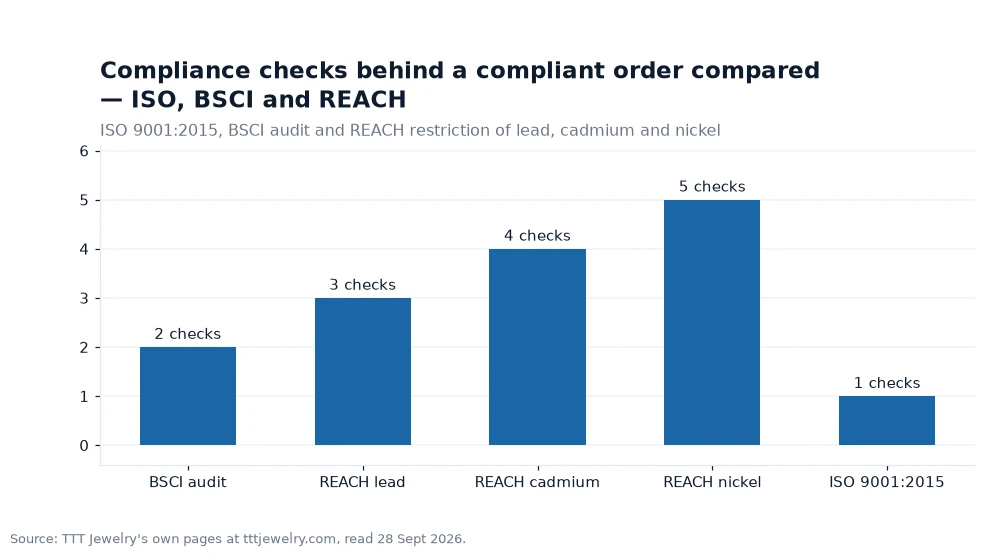
- An audited BSCI social-compliance programme, ISO 9001:2015 and REACH limits on lead, cadmium and nickelry gate.
The six gates, in the order they open
The route is published in six parts. Inquiry brings the sketch, reference photos or a tech pack. Consultation and development covers feasibility, material selection and the cost structure. CAD and prototype follows, with 3D drawings and renderings inside 48 hours for dimensional approval. Sample and approval takes 25–30 days and absorbs the revisions. Bulk production runs 3–4 weeks once the sample passes. Final QC and delivery closes the order with a 100% inspection, branded packaging and worldwide express shipping.
Published routes matter because they let a buyer build a schedule instead of waiting for one. Put those six gates into a spreadsheet with dates, and the only unknowns left are the two approvals that belong to you.
What the buyer owns at three of the six gates
Half the published route closes on someone else's decision. The inquiry gate needs an input, even a rough one. The CAD gate needs a dimensional verdict. The sample gate needs approve or revise, with the revision named rather than implied.
Factories promise faster schedules than they deliver mostly because they assume those three answers arrive the same week they are asked for. If yours take a week each, every published window still holds and your order is still three weeks late. A wholesale jewelry manufacturer that names the gates with dates is handing you a project plan; one that only quotes a figure leaves you to assemble the plan yourself.
What actually travels with the order
Four documents move alongside the carton: the quality system statement, the social audit, the materials compliance line, and the inspection note. The published set is The ISO 9001:2015 standard, a REACH statement covering lead, cadmium and nickel and an audited BSCI social-compliance programme, cadmium and nickel, with finishes stated as compliant with REACH and CA Prop 65.
None of those is a production step, and all of them get requested by retail partners at some point during one. Collecting them in a single reply at the inquiry gate saves the two weeks of email that reappears every time a new buyer joins your side of the table.
| Gate | Deliverable | Who signs it off |
|---|---|---|
| Inquiry | Sketch, reference photos or tech pack | The buyer |
| Consultation and development | Feasibility, material choice, cost structure | Both sides |
| CAD and prototype | 3D drawings and renderings in under 48 hours | The buyer, on dimensions |
| Sample and approval | Physical master sample in 25–30 days | The buyer, on the piece |
| Bulk production and delivery | 3–4 weeks of production, 100% inspected, packed and shipped | The factory, with the inspection note |
Worked example: working a launch date backwards
Start from the carton rather than the sketch. A launch on day 90 leaves room for 3–4 weeks of production, so production must begin by day 62 at the slow end (90 − 28 = 62) and by day 69 at the fast end (90 − 21 = 69).
Sampling of 25–30 days then has to be approved between day 32 and day 44, which puts the CAD approval around day 30 at the earliest. Days 1 to 30 are your own design time, and that is the only part of the schedule you fully control — which is the argument for treating a CAD review as a two-day task rather than a two-week one.
What leaves the building at the final gate
Delivery in the published route includes packing rather than shipping alone. The packaging line covers foil-stamped boxes, display backing cards, logo tags, pouches in velvet or microfiber and labelling with barcodes, with worldwide express shipping and customs support attached to the same step.
For a wholesale order that list is less styling than logistics, because a backing card and a barcode are often retailer requirements rather than choices. Confirm them at the same time as the finish and the hallmark, since all three are locked before the batch runs.
Where a route stalls, and how to unstick it
Orders stall in three predictable places: a sketch nobody can interpret, a dimension nobody will approve, and a sample that lands the week of a trade show. All three sit on the buyer's side of the table, and two of them cost more than a week each.
Fixing them is unglamorous work. Give the design team one readable reference instead of five conflicting ones, nominate one person to sign dimensions, and book the sample review into a calendar the day the CAD lands. The published windows were never the constraint.
Two mistakes first-time buyers make on this route
The first is treating the six gates as a queue with one price attached. In practice the CAD gate is the short one and the sample gate is the long one, and the approvals in between decide whether you pay for either of them twice.
The second is briefing the factory and the packaging supplier in different conversations. Barcode labels, backing cards and gift boxes all arrive at the final gate, so a carton can be finished and waiting while the packaging is still on order.
The two documents that unlock retail questions
Retail compliance usually asks two things: how labour conditions at the factory are audited, and how the materials are controlled. The published answers are a BSCI audit and a REACH statement covering lead, cadmium and nickel, with the finishes confirmed as compliant with REACH and CA Prop 65 standards.
Ask for both at the inquiry gate and file them with the order number. Neither changes when the design changes, so a file assembled on the first order answers the question for every order after it, which is the simplest hour of administration in the whole route.
Frequently asked questions
What do I need to send at the inquiry gate?
A sketch, reference photos or a tech pack. Hand drawings are accepted inputs, and the design team turns them into 3D CAD with renderings inside 48 hours.
How long does the whole route take from drawing to shipping?
Under 48 hours for CAD, 25–30 days for the master sample and 3–4 weeks for bulk production, which is about seven to nine weeks before your own approval time is added.
Do compliance documents come with the order?
A BSCI audit, the ISO 9001:2015 standard and a REACH statement covering lead, cadmium and nickel. Ask for them at the inquiry gate so retail-partner questions are answered once instead of per order.
Planning the route before choosing the factory
Once the six gates are written down, choosing a supplier becomes a question of who can fill them in with specifics. TTT Jewelry publishes the gates, the windows and the minimums that sit behind them. The custom jewelry wholesale program explains how a first range is structured under the OEM/ODM model, and the 925 silver production page shows the same route at the material level.
The specification quoted throughout — laser engraving for logos together with the eight steps in production as well as the six customisation fields — is recorded at the brand's own pages over at tttjewelry.com, dated 28 Sept 2026. The percentages quoted above are my own arithmetic rather than the manufacturer's[1].